

The five common types of power of attorney (POA) are durable, springing, general, financial, and medical. A durable POA keeps working if you become incapacitated, and a springing POA starts only when a set event happens. General and financial POAs cover money, property, and legal matters, and a medical POA covers healthcare decisions.
We all do our best to be prepared for any situation, and to care for the people we love. But sometimes unexpected things can happen to us, like a car accident or illness, that make us unable to look after ourselves or manage our affairs. In these situations, a power of attorney can help.
A power of attorney, or POA, is a legal document that lets you grant another person the authority to make decisions on your behalf. This person is called your agent (or attorney-in-fact). For healthcare decisions, the agent is often called a healthcare proxy. POAs are powerful documents that help make sure important decisions about your family, finances, and healthcare will be handled, even if you can’t make these decisions yourself.
There are many types of POAs, and understanding them will help you choose one that’s the best fit for you. You may also see lists of four types, which usually sort POAs by when they take effect (durable or springing) and how much they cover (general or limited). Below, we break down the most common types, including the financial and medical POAs used in estate planning. If you already know what you need, you can make a free durable financial power of attorney and advance healthcare directive with FreeWill.
1. Durable power of attorney
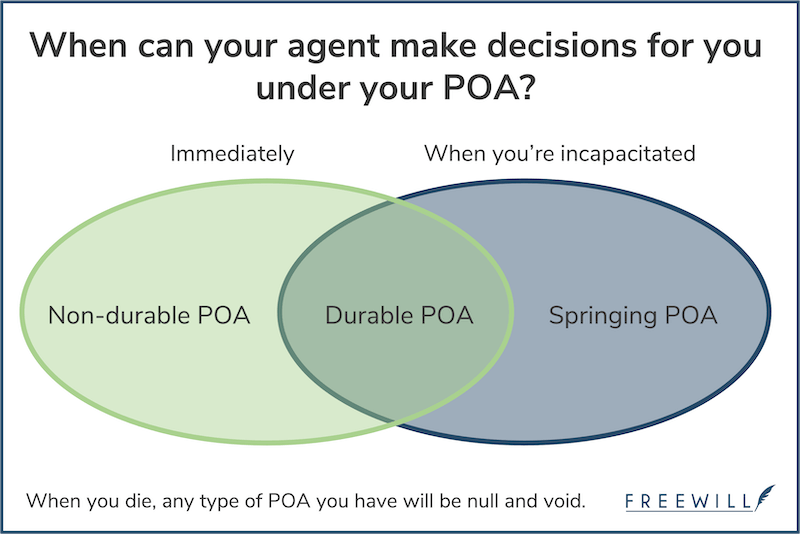
Having a durable POA means your agent’s authority to act on your behalf continues if you become incapacitated, for example, if you fell into a coma. If you’re using your POA for estate planning, it’s typical for it to be durable, because you’re planning for a situation where you might not be able to make decisions on your own. In states that follow the Uniform Power of Attorney Act, and in New York, a POA is durable unless it says otherwise. Other states, such as Florida and California, require the document to say that it stays in effect if you become incapacitated. Either way, it’s a good idea to explicitly state in your POA document whether you want it to be durable, to avoid potential confusion.
Non-durable power of attorney
With a non-durable POA, your agent’s power to act ends if you become incapacitated. Non-durable POAs aren’t typically used for estate planning, but can be useful in other scenarios. For example, you might grant your stock broker a non-durable POA so they can manage your investments day-to-day.
2. Springing power of attorney
Unless it says otherwise, a POA is usually effective as soon as it’s signed, and your agent can start exercising the powers you granted them right away. This can be useful when you’re using your POA for business or financial purposes. For example, if you own a business and move overseas, you can appoint an agent to manage it for you while you’re away.
A springing POA, on the other hand, only gives your agent the power to act when a specified condition is met. When used for estate planning, the condition is typically that you’ve become incapacitated and can’t act for yourself. Once the condition is met, your agent’s power “springs” into effect. Until then, your agent has no legal authority, and you are the only one with control over your affairs.
Although a springing POA ensures your agent can’t use their powers unless you’re incapacitated, springing POAs can cause problems in estate planning, and some states, such as Florida, generally don’t allow new ones. The process of determining whether you’re incapacitated isn’t always straightforward, and can take time. Under the Uniform Power of Attorney Act, your POA can name who decides that you’re incapacitated. If it doesn’t, that’s usually a doctor or, in some states, a licensed psychologist.
For example, if you develop dementia, it may not be clear whether or not you can manage your affairs. Your agent, doctors, and loved ones may have different opinions about what it means to be incapacitated. These delays and difficulties could mean that your agent can’t act on your behalf right away, leaving bills unpaid, delaying decisions about your medical care, and preventing your family from receiving financial support that you normally provide. A non-springing POA avoids these issues, and you can instruct your agent to only use their powers if they reasonably believe you’re incapacitated. Your agent has a legal duty to act within the authority you give them and according to your wishes, as far as they know them. A durable financial POA made with FreeWill is effective immediately, and you can include instructions about when your agent should start acting.
If you’re considering a springing POA, it may be beneficial to speak to an estate attorney about your situation.
3. General power of attorney
With a general power of attorney, you authorize your agent to act for you in all situations allowed by local law. This usually includes financial, legal, and business matters. Healthcare decisions are generally handled in a separate medical POA or advance healthcare directive. General POAs can be durable or non-durable, depending on your preferences.
A general POA gives your agent considerable power over your affairs, but there are still some things they can’t do. For example, they can’t enter into a marriage on your behalf, or make changes to your last will and testament.
Limited (special) power of attorney
A limited POA, sometimes called a special POA, lets your agent handle only the specific tasks you name. The American Bar Association gives the example of a POA limited to closing the sale of your home.
4. Financial power of attorney
A financial POA lets your agent make decisions about your money and property. It can be broad, covering most of your finances, or limited to the tasks you choose. For example, you could grant your agent the authority to:
- Pay your bills and your family’s expenses
- Make bank deposits and withdrawals
- Manage your retirement accounts
- Sell or rent your real estate
- File your taxes
You can choose which powers you want your agent to receive. For example, maybe you only want your agent to pay your bills or manage your property. And financial POAs can be durable or non-durable, depending on your preferences. A financial POA usually doesn’t let your agent manage Social Security benefits. Even an agent with a POA must apply to the Social Security Administration to become the person’s representative payee.
5. Medical power of attorney
A medical POA, also called a healthcare POA or healthcare proxy, lets your agent make healthcare decisions for you if you can’t make them yourself. This could include decisions about your medical care, like:
- Medical treatments
- Medication
- Surgery
- End-of-life care
- The doctors and hospitals used to administer your care
For example, if you’re too sick to let doctors know whether you want to receive a feeding tube, your healthcare agent can make that decision for you. A medical POA is often part of an advance healthcare directive, which can also include a living will.
When does your agent’s authority to act for you end?
This depends on the type of POA you’re using.
With a non-durable POA, your agent’s authority ends as soon as you become incapacitated. If you have a durable POA, your agent can continue to make decisions for you even after you become unable to make them yourself. A springing POA starts when the condition it names happens, such as your incapacity. After that, it generally stays in effect until it ends for another reason, such as your death or revocation, unless the document says otherwise. You can also revoke any POA while you’re still able to make decisions.
When you die, your agent’s legal authority to make decisions for you ends, regardless of which type of POA you have in place. If you want to plan who should receive your property and other assets when you pass away, consider making a last will and testament. After your death, the executor of your estate handles your affairs.
Which type of POA should you choose?
The best type of POA for you will depend on your preferences, and the particular situation you’re planning for. If you’re creating a POA to plan for a situation where you could suddenly become incapacitated, such as after a car accident or because of a health condition, you’ll likely want a durable financial POA and a medical POA.
If you want one trusted person to handle both your finances and your healthcare, you can name the same agent in your financial POA and your medical POA. If you’d rather give different people responsibility for managing your finances and your healthcare, you can create separate financial POA and medical POA documents. If you do name two different agents, it’s a good idea to choose people you trust and who will get along with each other. There may be a time when they need to work together. For example, your financial agent may need to use your money to pay for a medical treatment your healthcare agent chose for you. Signing rules also vary by state, and our guides for California, Florida, New York, and Texas cover the requirements. If you’re helping a parent, see how to get power of attorney for a parent or loved one.
Frequently asked questions
What are the 4 types of power of attorney?
Lists of four types usually include general, limited (or special), durable, and springing POAs. These categories overlap. General and limited describe how much authority your agent has, while durable and springing describe when it starts and whether it keeps working if you’re incapacitated. Financial and medical POAs describe the kind of decisions your agent makes.
Which type of power of attorney covers everything?
No single POA covers every decision. A general durable financial POA covers most money and legal matters, and a medical POA or advance healthcare directive covers healthcare. A POA generally can’t be used to make or change your will. Under the Uniform Power of Attorney Act, powers like making gifts or changing beneficiary designations have to be granted specifically.
What is the difference between a durable and a springing power of attorney?
A durable POA can take effect right away and keeps working if you become incapacitated. A springing POA takes effect only when a condition it names happens, usually your incapacity, which someone may have to confirm first. Not every state allows springing POAs. Florida, for example, generally doesn’t allow new ones.
Can a power of attorney be used for Social Security benefits?
Not on its own. The Social Security Administration says that even if you hold power of attorney, you must still apply to serve as the person’s representative payee. The Consumer Financial Protection Bureau’s guide for agents notes that VA benefits also need a separate appointment.
When does a power of attorney end?
Every POA ends when the person who made it dies, and a non-durable POA also ends if they become incapacitated. You can revoke a POA at any time while you’re still able to make decisions, and the CFPB suggests telling banks and others who have a copy. After death, the executor of the estate takes over.
Get started with a free power of attorney
Ready to create your POA? Here are eight steps to quickly and easily create your power of attorney. You can also use FreeWill to create a free durable financial POA and an advance healthcare directive, which can include a healthcare POA and a living will.
Make your free estate plan today

Make your free advance healthcare directive
Make your free durable power of attorney
Make a stock donation today
Make your free revocable living trust